Lab-Grown vs Natural Diamonds: What’s the Real Difference?
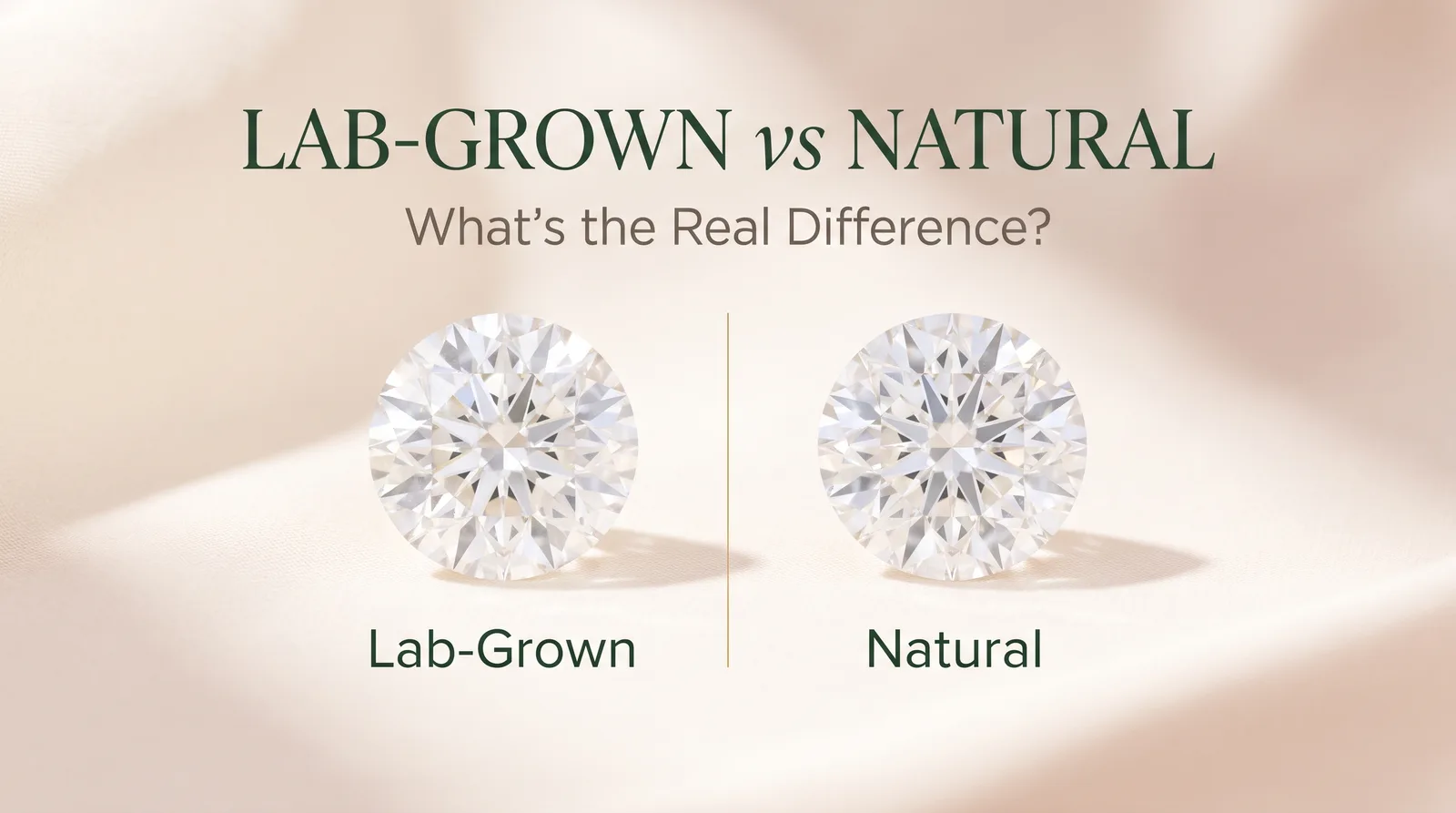
Lab-grown diamonds and natural diamonds look the same, test the same and are graded by the same kinds of labs. So what actually sets them apart? Here is a plain-language comparison to help you decide which one fits your budget and your values.
Are lab-grown diamonds real diamonds?
Yes. A lab-grown diamond is a diamond. According to GIA, natural and lab-grown diamonds are both carbon crystals with essentially the same chemical, physical and optical properties. That means the same hardness (10 on the Mohs scale), the same brilliance and the same durability. The U.S. Federal Trade Commission recognized this in 2018, when it updated its Jewelry Guides so that the word “diamond” no longer has to mean “natural.” What the guides require instead is clear disclosure of how a stone was made.
How are they made?
A natural diamond forms deep underground over a very long time, up to about three billion years. A lab-grown diamond is grown in a controlled environment and typically takes less than a month. There are two main methods:
- HPHT (high pressure, high temperature): recreates the conditions deep in the earth around a small diamond seed.
- CVD (chemical vapor deposition): builds the crystal layer by layer from a carbon-rich gas onto a diamond seed.
Once grown, the rough crystal is cut and polished in the same way as a mined diamond.
Can you tell them apart?
Not by eye, and not with a basic diamond tester. Telling them apart takes specialist laboratory equipment. GIA, for example, tests every diamond submitted to its labs to determine whether it is natural or lab-grown, and issues separate reports for laboratory-grown diamonds. This is one reason a grading report is worth asking for: it states the stone’s origin along with its cut, color, clarity and carat weight.
How do they compare on price and value?
Lab-grown diamonds generally cost significantly less than natural diamonds of the same size and quality, so you can often choose a larger or higher-quality stone for the same budget. The size of the gap changes with the market and with the individual stone, so compare the same carat weight, color and clarity side by side.
One honest caveat: lab-grown diamonds usually hold less resale value than natural ones. They are best thought of as something to wear and enjoy, not as an investment.
What about sustainability?
Neither option is impact-free. Mining moves a great deal of earth, while growing diamonds takes a lot of energy, and the footprint of a lab-grown diamond depends heavily on the energy source the producer uses. Be cautious of any seller that calls its diamonds “eco-friendly” without explaining how they were made. Still, many buyers choose lab-grown because it avoids the concerns about origin that can come with mined stones, and that is a reasonable choice.
Three common myths
- “They fade or turn cloudy.” No. They have the same hardness and durability as natural diamonds and will not lose their sparkle with wear.
- “They are cubic zirconia or moissanite.” No. Those are different materials. A lab-grown diamond is pure carbon, just like a natural one.
- “Lab-grown means lower quality.” Quality is judged on the same factors, cut, color, clarity and carat weight, so it depends on the individual stone, not on where it was grown.
At a glance
- Chemistry and hardness: the same (carbon, 10 on the Mohs scale).
- Appearance: identical to the eye.
- Time to form: up to about three billion years versus typically under a month.
- Price: lab-grown is generally lower for the same size and quality.
- Resale value: natural is generally higher.
- Disclosure: origin should be clearly stated for both.
Which should you choose?
Choose lab-grown if you want more size or quality for your budget, like the idea of a modern origin story, and plan to wear the piece rather than resell it. Choose natural if rarity and long-term value matter most to you, or if you love the idea of a stone formed over billions of years. Both are real diamonds, and neither is a “fake.”
Whichever you choose, ask for the grading report, check that the origin is clearly stated, and buy from someone who answers your questions plainly.
Lioralove offers lab-grown diamond jewelry in solid 14K and 18K gold. Browse our fine jewelry collection, or get in touch if you would like help choosing. Certificate details vary by piece, so ask us about the one you like and we will confirm what is included.